My pick is the Drip EZ Rest EZ for its straightforward bag design and a published brisket test with clearly stated conditions. Choose the Meat Swadl for an adjustable wrap. Keep your cooler and towels if they already work: a BBQ resting blanket is a convenient passive insulator, not a heated holding cabinet.
| Option | Best reason to choose it | Fit reference | Main limitation |
|---|---|---|---|
| Drip EZ Rest EZ | Simple wide-opening bag | 21.25 × 16 × 8 in | Hand wash; contain juices and keep upright |
| Meat Swadl | Adjustable fold-and-close design | 20 × 14 × up to 8–9 in | Fleece liner needs protection from juices |
| ChefsTemp FinalRest | Specified 8 mm insulation | Confirm usable internal dimensions before buying | Maker specifies a 200°F / 93°C maximum internal temperature |
| Existing cooler and clean towels | No extra purchase | Measure your wrapped meat and tray | Uses the cooler and creates towels to wash |
Maker specifications checked October 2026: Drip EZ, Meat Swadl and ChefsTemp. Listed dimensions are not verified usable internal capacity. All three occupy a similar modest accessory-price band at the check date; compare current totals and delivery.
These products are insulated bags or wraps for cooked meat after it leaves the smoker. They are different from a smoker’s exterior insulation jacket and from butcher paper or foil used during cooking.
The useful buying question is not “which promises the most hours?” It is whether the bag fits your brisket, contains the mess and makes your normal resting setup easier to handle.
Which BBQ resting blanket should you buy?
1. Drip EZ Rest EZ: Best straightforward resting bag
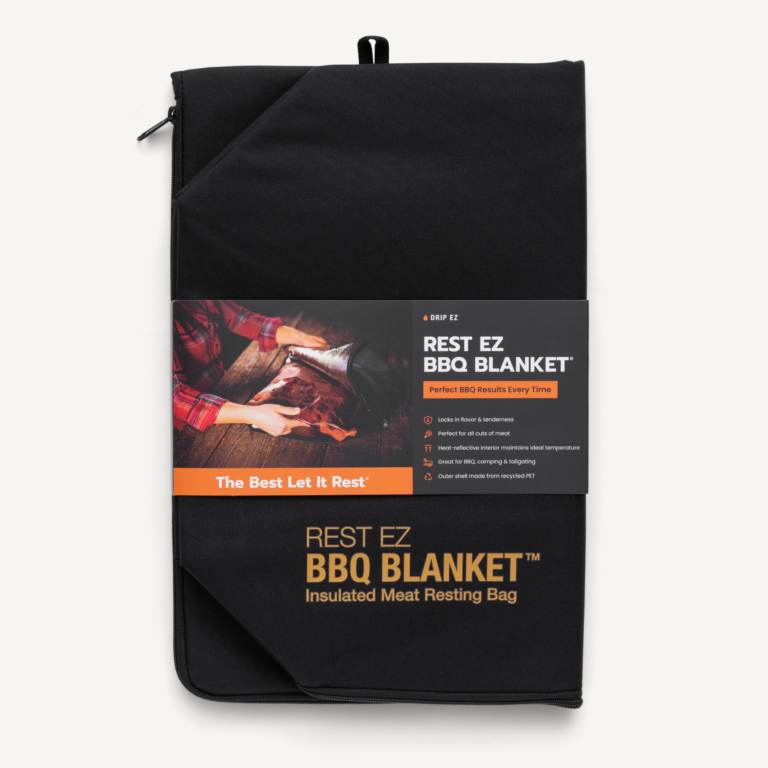
The Rest EZ is the simplest starting point here: a wide-opening, zippered bag with a heat-reflective interior. Its shape makes more sense if you want to load a wrapped roast without folding a blanket around it.
Key specs: 21.25 × 16 × 8 inches; PET exterior; hand wash and air dry. Drip EZ says to keep it out of ovens, grills and smokers.
The useful independent evidence is Max Good’s AmazingRibs Rest EZ review. He put a double-foil-wrapped brisket in a tray, inside the bag, inside a cooler. It went from 205°F (96°C) to 145°F (63°C) over four hours.
That supports the combined setup, not a four-hour guarantee for the bag alone.
A verified owner, Elisabeth D., reported zipper leakage and difficult cleaning on the maker’s page. That is one report, not a failure rate, but it is a reason to contain the juices and keep the bag upright.
Pros
- Wide opening for loading
- Clearly listed dimensions
- Published brisket test with a documented setup
Cons
- Four-hour review result also used a cooler
- Hand washing and drying required
- Owner report of zipper leakage
Skip it if: you need powered temperature control or already have a cooler setup that is easy to clean and carry.
2. Meat Swadl: Best adjustable wrap
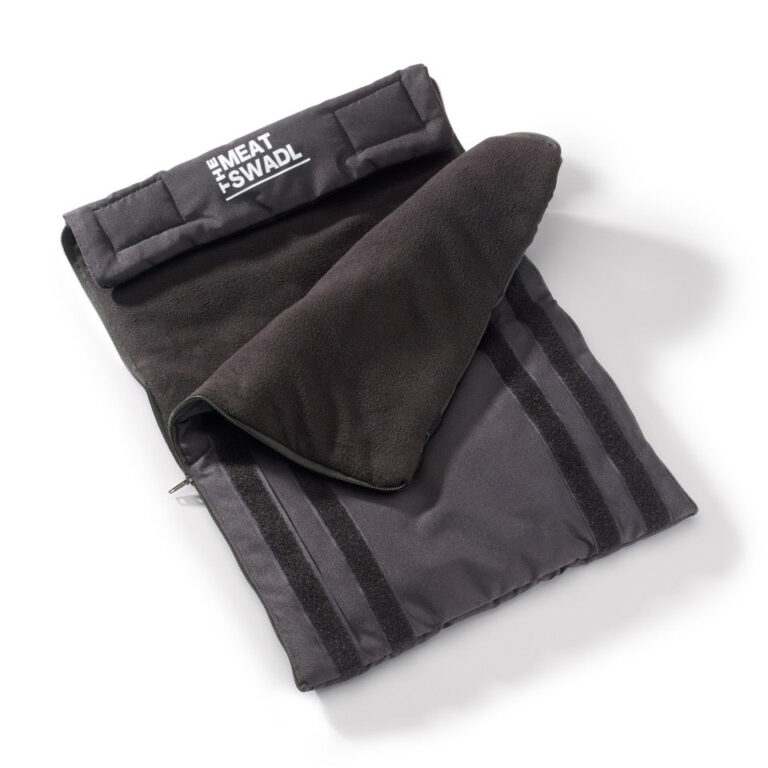
The Meat Swadl suits a cook who prefers to close the insulation around the parcel. Its two side zips and hook-and-loop flap let you tuck the excess material rather than treating every roast as a full-size bag load.
Key specs: 20 × 14 inches, up to 8–9 inches high; polyester outer, cotton-silk filling and polar-fleece lining. The instructions call for foil to contain juices, even over butcher-paper-wrapped meat, followed by hand washing and air drying.
The tradeoff is the fabric interior. If your usual butcher-paper wrap becomes saturated, the extra foil matters: it separates the wet parcel from the fleece. Choose the adjustable closure when storage and loading are your priorities.
Pros
- Adjusts around the wrapped food
- Opens on both sides
- Folds for storage
Cons
- Fleece can collect drips
- Extra foil is part of the instructions
- Hand wash and allow time to air dry
Skip it if: you want a smooth-lined bag with one zip, or do not want to add a juice-containing outer wrap.
3. ChefsTemp FinalRest: Best for a wipe-clean exterior
FinalRest is worth comparing if you want an exterior you can wipe with a damp cloth. ChefsTemp also specifies an 8 mm insulation layer and reflective lining. Check the temperature ceiling and usable fit first; those restrictions matter more than insulation thickness alone.
Key limits: the maker specifies a maximum internal temperature of 200°F (93°C), no cooking or reheating, and no machine washing. Confirm usable internal dimensions before ordering; a claimed meat weight does not establish whether your tray fits.
That temperature limit matters if your brisket leaves the cooker above it. Follow the product’s limit rather than assuming every bag accepts food straight from any finishing temperature.
Pros
- Insulation thickness specified
- Reflective liner
- Exterior designed to wipe clean
Cons
- 200°F maximum needs attention
- Internal fit needs confirmation
- No machine washing
Skip it if: you cannot verify tray fit or need to load above the stated temperature limit.
Is a resting blanket better than a cooler and towels?
It may be more convenient, but “better” needs a specific job. A dedicated bag can keep your everyday towels out of the barbecue routine and avoid tying up a bulky cooler. It does not automatically improve the meat or replace temperature monitoring.
| Your situation | What I would choose | Reason |
|---|---|---|
| Your cooler-and-towels routine already works | Keep it | There is no need to buy a bag just to rest a brisket |
| You want less bulky storage | A folding bag or wrap | Convenience is the clearest reason to change |
| You need to transport a juicy roast | A supported, contained parcel that fits the chosen carrier | Soft insulation is not a rigid spill-proof tray |
| You need a long, predictable hot hold | Suitable temperature-controlled holding equipment | A passive bag keeps losing heat |
No option in this table establishes a universal safe holding duration. Verify the food temperature in the actual setup.
In a BBQ owner discussion about Rest EZ, the starting question was whether to replace butcher paper, towels and a cooler. That is the right comparison. General enthusiasm for a new accessory does not tell you which part of an existing routine it improves.
Keep the cooking wrap decision separate. Butcher paper and foil behave differently; putting either inside an insulated bag does not erase those differences or make a wet parcel leak-proof.
What should you look for in a brisket resting bag?
| Factor | Why it matters | What to check |
|---|---|---|
| Usable fit | A roast’s weight does not describe its shape | Wrapped length, width and height, plus any tray |
| Opening | A roomy bag can still have a restrictive mouth | Whether the supported parcel can enter without tipping |
| Juice containment | Grease can reach seams and closures | Wrap instructions and a stable, compatible tray |
| Cleaning | Fat-soaked fabric creates more work | Liner material, washing method and drying access |
| Temperature limit | Resting bags are not cooking equipment | The maker’s maximum and prohibited heat sources |
| Monitoring | Feeling the outside cannot establish food safety | A suitable food probe and a closure that does not damage its cable |
Measure your complete resting parcel, not the raw meat at the supermarket. Product dimensions alone do not prove the opening or internal clearance.
For a fit check, place your empty tray and a roughly sized parcel inside before the cook. The bag should close without crushing the contents or forcing a zip across a sharp foil edge. Check the same arrangement inside your cooler if you intend to combine them.
How long can you safely hold meat in a resting blanket?
There is no fixed safe number of hours for every roast and bag. Starting temperature, meat size, room conditions, opening frequency and the rest of the insulation all matter. A smaller pork shoulder is not a repeat of a whole-packer brisket test.
USDA guidance says to hold hot food at 140°F (60°C) or above. Use a food thermometer to monitor the meat. A bag that feels warm on the outside does not establish the temperature at the relevant part of the food.
Resting and hot holding are different decisions. A recipe may call for a rest before slicing; keeping cooked food for a later meal adds a temperature-control problem. Passive insulation delays cooling but supplies no replacement heat.
If the temperature is falling toward the safe holding limit, act before you lose control of the schedule: serve, use suitable heated holding equipment, or follow safe cooling and storage guidance. Do not rely on a blanket to reheat cooled meat.
USDA’s danger-zone guidance says to discard perishable food left without safe temperature control for more than two hours, or one hour above 90°F (32°C). Do not use reheating as a way to rescue food whose time and temperature history is unsafe or unknown.
For safely stored leftovers, use the brisket reheating guide. A suitable leave-in thermometer is a more useful companion to any resting setup than a marketing promise about hours.
How do you use a BBQ resting blanket?
- Finish the cook before loading. The bag supplies no heat. Check the meat against the recipe’s doneness and food-safety requirements, then respect the bag’s temperature limit.
- Contain the juices. Follow the wrap instructions, including the Meat Swadl’s additional foil layer over butcher paper. Use a compatible tray where the bag and opening allow it.
- Support the whole parcel. Put the bag on a stable, heat-safe surface, load without tipping, and close it without forcing the zip or pinching a thermometer cable.
- Monitor the hold. Use a suitable food probe and keep the bag closed between necessary checks. Decide in advance when you will serve or move the meat to temperature-controlled equipment.
- Clean and dry before storing. Follow the liner’s care instructions, particularly if juices escaped the wrap. Do not pack away damp fabric.
Will a resting blanket soften brisket bark?
A tightly wrapped, insulated rest favors heat retention over a dry exterior. The cooking wrap matters: foil traps moisture around the meat, while the bag adds insulation outside it. A bag does not restore bark that has already softened inside a wet wrap.
ThermoWorks’ resting guidance explains the tradeoff between conserving heat, carryover cooking and preserving a crisp surface. Insulation can affect the temperature after cooking; do not assume every cut needs the longest possible hold.
For a short rest before serving, a dedicated bag may add little to your routine. For a longer hold, prioritize temperature control and accept the wrap’s texture tradeoff. Avoid an arbitrary uncovered cooling period that ignores the meat temperature and your serving time.
How I chose these resting blankets
I compared the current maker information for fit, closure, liner, care and temperature restrictions, then checked what the available reviews actually measured. Max Good’s AmazingRibs test was useful because it identified the wrapping, tray and cooler as well as the meat temperatures.
I also read individual customer comments on the Drip EZ, Meat Swadl and ChefsTemp pages, plus the linked BBQ owner discussion. I used them to identify cleaning and handling questions, not to calculate failure rates or turn unmeasured warmth into a food-safety claim.
I kept the shortlist to three distinct designs instead of padding it with near-identical bags whose maker details or test conditions were unclear. There is no thermal-performance winner across all three. My preference for Rest EZ reflects its straightforward format and the clearer published evidence; the cooler-and-towels option remains the right choice when it already meets your needs.
Buy a resting blanket for a specific convenience: easier storage, a dedicated wrap or a carrier that suits your parcel. Choose Rest EZ as the straightforward starting point, Meat Swadl for adjustability, or compare FinalRest after checking its limits. Keep an existing cooler setup if it already works.
