My pick: the Kegco K309SS-2, a two-tap kegerator that takes any full-size keg, Coors and Miller kegs included, and chills from 32°F (0°C). It’s an indoor unit. For a patio that’s open to the weather: the Summit SBC683OSTWIN. Built into an outdoor kitchen: the True TUR-24DD. Homebrew kegs: the Kegco HBK309S-2. Narrow space: the 20-inch Kegco K199SS-2. Mini kegs: the SPT BD-0538.
Keeping it outside? Only three units here are rated for it by their makers. See Can you keep a kegerator outside?
The first thing to check is the keg, not the kegerator. A 24-inch kegerator can hold a half barrel, or it can’t, and some won’t take the bulged Coors and Miller kegs at all. The keg table shows what fits each one.
| Kegerator | Best for | Biggest keg | Taps | Outdoor-rated? | Width | Price | |
|---|---|---|---|---|---|---|---|
| Kegco K309SS-2 | Best overall | Half barrel, incl. Coors and Miller | 2 | No | 23.5 in | $$ | Check price |
| Summit SBC683OSTWIN | Best outdoor | Half barrel | 2 | Yes (weatherproof, per Summit) | 23.75 in | $$$ | Check price |
| True TUR-24DD | Best built-in for an outdoor kitchen | Slim quarter barrel | 2 | Yes (UL, per True) | 23 7/8 in | $$$$ | Find a dealer |
| Kegco HBK309S-2 | Best for homebrew kegs | Half barrel; set up for ball-lock kegs | 2 | No | 24 in | $$ | Check price |
| Kegco K199SS-2 | Best for narrow spaces | Half barrel, straight-sided only | 2 | No | 20 in | $$ | Check price |
| SPT BD-0538 | Best for mini kegs | 5-liter mini keg | 1 | No | 10.7 in | $ | Check price |
Specs from each maker’s product page, October 2026. Price bands: $ under $300 · $$ $300–1,200 · $$$ $1,200–3,000 · $$$$ over $3,000. Kegco and SPT bands use the price on their own stores; True’s page lists its price; Summit sells through dealers and lists none, so its band is from a dealer listing (BBQGuys). True sells only through dealers, so its button goes to True’s page.
How I chose
I compared the home kegerators on Kegco’s, Summit’s, True’s, Danby’s and SPT’s sites in October 2026, then picked six that each fit a different keg, place or budget. Keg counts, temperatures and outdoor wording come from each maker’s product page. The draft settings come from Kegco’s, Summit’s, Danby’s and Micro Matic’s guides, and the CO2 safety figures from NIOSH.
I also read owner threads on the Homebrewers Association, Northern Brewer and Brewer’s Friend forums for the problems that keep coming up: foamy first pours, sticky faucets and kegs that don’t fit. Those points are in the buying guide. Prices come from the makers’ stores, or a dealer listing where a maker sells only through dealers.
Every pick is listed as current on its maker’s site. Two brands didn’t make it:
- Danby’s DKC054A1 keg cooler shows as out of stock in Danby’s US store, and its page doesn’t list which kegs fit.
- EdgeStar’s site now forwards to the Ferguson Home store, which blocked my checks, so I couldn’t confirm current models or specs.
I searched CPSC’s recall notices and found none for a kegerator, beer dispenser or CO2 regulator. Where a maker doesn’t publish a figure, the tables show a dash, not a guess.
| Kegerator brand | What it makes | Where it sells |
|---|---|---|
| Kegco | Freestanding, built-in, outdoor, homebrew, kombucha and cold-brew kegerators | Its own store and retailers |
| Summit | Built-in and freestanding indoor/outdoor kegerators; wine, coffee and kombucha tap kits | Dealers |
| True | Premium undercounter beverage dispensers, UL rated for outdoor use | Dealers |
| SPT (Sunpentown) | Countertop mini kegerator for 5-liter kegs | Its own store and retailers |
| Danby | Indoor freestanding keg coolers | Its own store (out of stock) and retailers |
From each brand’s own site, October 2026.
Which kegerator fits which keg?
A full-size kegerator takes one half barrel, or two or three smaller kegs side by side. The catches are in the details: True’s dual-tap unit tops out at a slim quarter barrel, and Kegco’s 20-inch model won’t take Coors or Miller kegs, which bulge in the middle.
| Kegerator | Half barrel (15.5 gal) | Quarter (7.75 gal) | Sixtel (5.16 gal) | Corny / ball-lock (5 gal) | 5 L mini keg | Taps | CO2 supply included | Outdoor-rated | Other drinks |
|---|---|---|---|---|---|---|---|---|---|
| Kegco K309SS-2 | 1, incl. Coors, Miller and rubber kegs | 1 | Up to 3 | Up to 3 | No | 2 | Two-keg dispense kit; CO2 tank not specified | No | Kegco sells kombucha and cold-brew models |
| Summit SBC683OSTWIN | 1 | 1 | Up to 3 | Up to 3 | No | 2 | 5 lb tank and regulator | Yes | Wine, coffee and kombucha tap kits |
| True TUR-24DD | No | 1 slim, plus 1 sixtel | 2 | — | No | 2 | Tank and regulator; size not listed | Yes (UL) | Converts to a beverage center or wine cabinet |
| Kegco HBK309S-2 | 1 | 1 | Up to 2 | Up to 3 (couplers included) | No | 2 | Ball-lock dispense kit; CO2 tank not specified | No | Doubles as a fermentation chamber |
| Kegco K199SS-2 | 1, straight-sided only | 1 | Up to 2 | Up to 2 | No | 2 | Dispense kit; tank mounts outside; tank not specified | No | — |
| SPT BD-0538 | No | No | No | No | 1, incl. Heineken 5 L | 1 | Three 16 g CO2 cartridges | No | — |
Keg counts from each maker’s product page, October 2026 (“up to” = the most that fit at once; you can only pour as many as there are taps). “—” = not published. Commercial beer kegs need the right coupler (most US beers use a D-system coupler); corny kegs need ball-lock or pin-lock fittings instead.

Keg sizes in pints: Kegco gives these 16 oz pint counts per keg:
- Half barrel (15.5 gal): about 124 pints. Also called a full-size keg.
- Quarter barrel (7.75 gal): about 62 pints, in a short “pony” or a tall “slim” shape.
- Sixth barrel or sixtel (5.16 gal): about 41 pints.
- Cornelius or corny keg (5 gal): about 40 pints. Homebrewers use these, with ball-lock or pin-lock fittings.
- 5-liter mini keg: about 10½ pints (5,000 ml ÷ 473 ml).
Did you know? At two pints a guest, one sixtel’s 41 pints covers a 20-person BBQ. A half barrel’s 124 pints covers about 60 guests. A 5-liter mini keg covers five.
Best kegerator overall
1. Kegco K309SS-2: Best overall
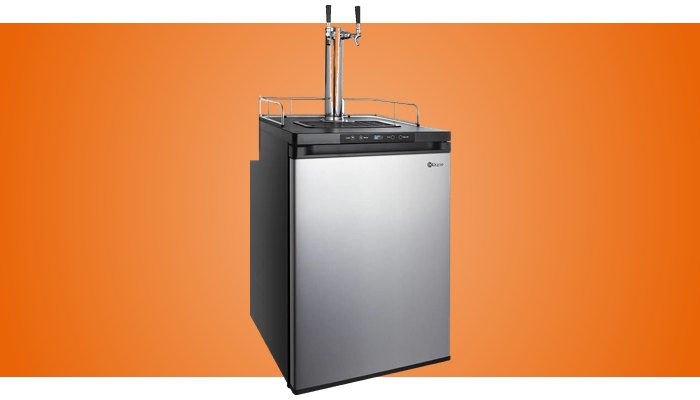
The K309SS-2 takes the widest range of kegs here. Kegco says it holds any full-size keg, including Coors, Miller and rubber kegs, or up to three sixtels or corny kegs. Two taps let you pour two beers at once.
Its digital control runs from 32°F to 75°F (0–24°C), with a fan to even out the cold. A Deep Chill button runs the compressor nonstop to cool a warm keg; left on a full 24 hours, Kegco warns, it may freeze it. Locking casters let it roll from room to room, but Kegco lists it as not outdoor ready.
Key specs: 2 taps · 1 half barrel, or up to 3 sixtels or corny kegs · 32–75°F digital control · fan-forced cooling · 23.5 × 35 × 23.5 in · 14 in tower · casters · converts to a fridge with 2 shelves · not built-in capable · not outdoor ready · also sold with 1 or 3 taps · $$
Pros
- Fits Coors and Miller kegs
- Chills to 32°F, tied for coldest here
- Digital control with Deep Chill
- Converts to a fridge
Cons
- Indoor only, per Kegco
- Can’t be built in
- Manual defrost
- CO2 tank size not listed
Skip it if: it will live on an open patio. Take the Summit, which is built for weather.
Best outdoor kegerators
Both of these vent from the front, so they can sit under a counter. Most kegerators vent from the back and need open space around them.
2. Summit SBC683OSTWIN: Best outdoor
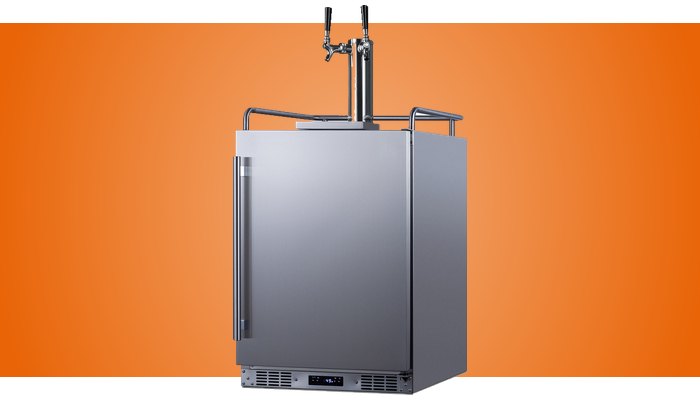
Summit calls the cabinet and door “weatherproof 304 grade stainless steel” designed for outdoor use, with a sealed rear against the elements. It breathes from the front, so it can be built in, and it comes with casters to stand free on a patio instead.
It takes a half or quarter barrel, or up to three sixtels or corny kegs, and pours from a twin tower. The kit includes a 5 lb CO2 tank and regulator. Automatic defrost means one less job, and the digital control runs from 34°F to 68°F (1–20°C).
It’s also the only pick whose maker says it sends cold air into the tower: an inside tube carries it up to the faucets. Owners blame a warm tower for most foamy first pours (see what to look for).
Key specs: 2 taps · 1 half barrel, or up to 3 sixtels or corny kegs · 5 lb CO2 tank, regulator and D-system (Sankey) coupler included · 34–68°F digital control · automatic defrost · cold air piped to the tower · 34 dB · front-breathing · 23.75 × 33.63 × 24 in; 51.5 in tall with the tower · 120 lb · 1-year parts and labor, 5-year compressor warranty · $$$
Pros
- Built for outdoor use
- Built-in or freestanding
- 5 lb CO2 tank included
- Cold air piped into the tower
Cons
- Sold through dealers only
- Doesn’t go as cold as the Kegco
- One-year parts and labor warranty
Skip it if: your kegerator stays indoors. The K309SS-2 does the same job for less. Kegco’s own outdoor model, the HK38SSC-2, is the alternative if you’d rather buy direct.
3. True TUR-24DD: Best built-in for an outdoor kitchen
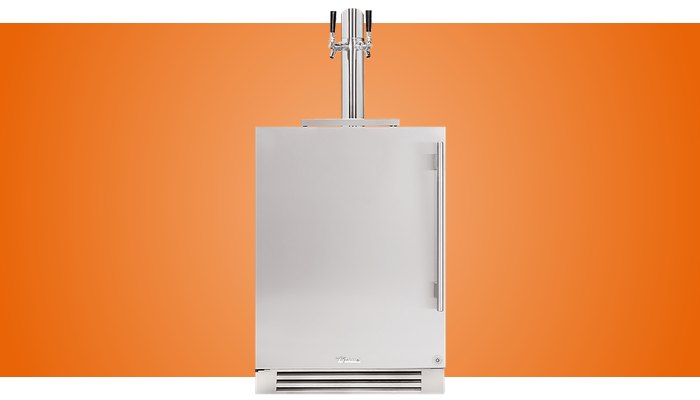
True is the only maker here that names a listing for outdoor use: it says all its undercounter models are “UL rated for outdoor use.” The cabinet is 300-series stainless inside and out, and zero-clearance hinges let the door open flush in a run of outdoor cabinets.
The trade-off is keg size. The dual-tap model holds two sixtels, or one slim quarter barrel and one sixtel, but not a half barrel. It comes with the tower, CO2 tank, regulator and a low-profile coupler, and it converts to a beverage center or wine cabinet.
Key specs: 2 taps · 2 sixtels, or 1 slim quarter + 1 sixtel · no half barrel · UL rated for outdoor use · CO2 tank, regulator and coupler included · 5.75 cu ft · 23 7/8 × 34 1/4 × 23 7/8 in · forced-air cooling, digital control · lock on stainless models · right hinge in stock; left hinge about 6 weeks · $$$$
Pros
- UL rated for outdoor use
- Stainless inside and out
- Flush built-in fit
- Lock included
Cons
- No half barrel
- Priciest pick by far
- Sold through dealers only
Skip it if: you want a full-size keg, or you aren’t building an outdoor kitchen. The Summit takes a half barrel and stands free.
Best kegerators for homebrew and small spaces
4. Kegco HBK309S-2: Best for homebrew kegs
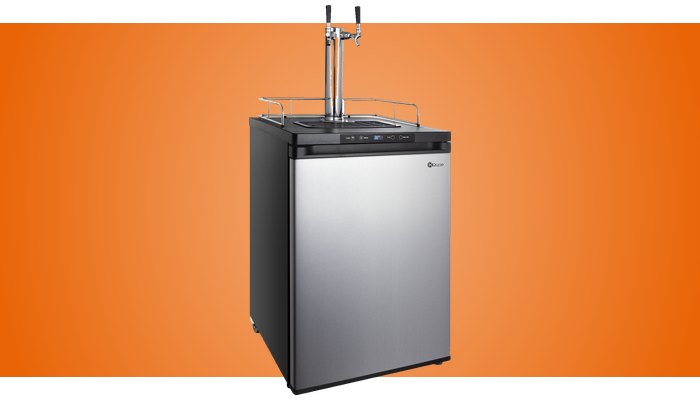
This is Kegco’s 24-inch digital kegerator set up for homebrew. It ships with a two-tap kit for ball-lock corny kegs, and it holds up to three of them, so one can chill while two pour.
Between batches, it works as a fermentation chamber. Kegco says it holds a 6-gallon bucket or carboy and goes warm enough to ferment, as well as down to 32°F to serve. Kegco’s specs also list room for a half barrel, though a store keg needs a commercial coupler, not the ball-lock fittings in the box.
Key specs: 2 taps · ball-lock homebrew kit · up to 3 corny kegs, or 1 half barrel · digital control, as low as 32°F · Deep Chill · 24 × 33.3 × 25 in · casters · reversible door · not outdoor ready · $$
Pros
- Ready for corny kegs out of the box
- Holds three corny kegs
- Doubles as a fermentation chamber
Cons
- Store kegs need a commercial coupler
- Indoor only, per Kegco
- Kegco doesn’t list the top temperature
Skip it if: you buy kegs instead of brewing. The K309SS-2 is set up for store kegs.
5. Kegco K199SS-2: Best for narrow spaces
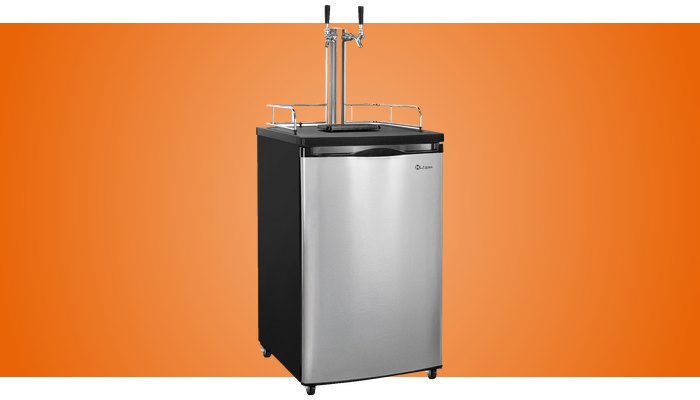
At 20 inches wide, it’s the narrowest kegerator here that still takes a half barrel. The catch: Kegco says it won’t fit bulged kegs that are wider in the middle, which Coors and Miller commonly use. Straight-sided half barrels, quarters and up to two sixtels or corny kegs fit.
The CO2 tank mounts outside the cabinet through a knockout, which frees room inside. Kegco’s kit puts only stainless steel in contact with the beer.
Key specs: 2 taps · 1 straight-sided half barrel, 1 quarter, or up to 2 sixtels or corny kegs · not Coors or Miller kegs · 20 × 33 × 25.5 in · 14 in tower · stainless beer contact · external CO2 tank mount · non-digital thermostat · casters · not outdoor ready · $$
Pros
- Only 20 inches wide
- Still takes a half barrel
- Stainless beer contact
Cons
- Won’t fit Coors or Miller kegs
- No digital temperature control
- Indoor only, per Kegco
Skip it if: you drink Coors or Miller from the keg. You need the 24-inch K309SS-2.
Best mini kegerator
6. SPT BD-0538: Best for mini kegs
The cheapest way to draft beer on this page. It sits on a counter, takes one 5-liter mini keg (SPT names Heineken’s), and pushes the beer with 16-gram CO2 cartridges, three in the box. SPT says the cartridges keep a keg fresh and carbonated for up to 30 days.
It cools thermoelectrically, from 36°F to 54°F (2–12°C), which is warmer than the compressor kegerators above. It weighs about 14 lb, so it can move to a covered patio table for an evening, but SPT gives it no outdoor rating.
Key specs: 1 tap · one 5-liter mini keg · 36–54°F (2–12°C) · thermoelectric cooling · 16 g non-threaded CO2 cartridges, 3 included · LED temperature display · 10.71 × 16.3 × 16.93 in · 13.9 lb · 65 W · assembly required · $
Pros
- Cheapest pick by far
- Fits on a counter
- No big CO2 tank to fill
Cons
- One 5-liter keg, about 10½ pints
- Coldest setting only 36°F
- Cartridges to keep buying
Skip it if: you’ll serve more than a handful of people. Five liters runs out fast at a party.
What to look for in a kegerator
Start with the keg you’ll buy, then the place it will stand. After that, the details that decide whether the beer pours well are the coupler, the temperature, the tower and the faucets.
| Factor | Why it matters | What to check | Picks that do well |
|---|---|---|---|
| Keg fit and inside space | Some cabinets won’t take a half barrel, or the bulged Coors and Miller kegs | The maker’s keg count for your size (keg table). Owners advise measuring the kegs you’ll actually buy | K309SS-2 (any full-size keg) |
| Coupler | The coupler has to match the keg’s valve or it won’t tap | D-system (US Sankey) for Anheuser-Busch, Miller, Molson Coors and most craft beer. Heineken uses S, Guinness U. Homebrew corny kegs need ball-lock or pin-lock | Summit (Sankey coupler in the box); HBK309S-2 (ball-lock) |
| Number of taps | You pour only as many beers as there are taps, however many kegs fit | 1, 2 or 3 taps; a two-tap unit with room for a third keg lets one chill while two pour | Five picks have 2 taps; the K309 also comes with 1 or 3 |
| Temperature control | Above 39°F (4°C) beer foams (settings) | Digital control that goes to 34°F or lower; a quick-chill mode for a warm keg | K309SS-2 and HBK309S-2 (32°F, Deep Chill) |
| Tower cooling | Beer sitting in a warm tower foams on the first pour | Cold air routed into the tower by a fan or tube; an add-on tower cooler fixes it later | Summit (cold-air tube) |
| Faucets | Standard faucets can stick when beer dries inside them | Forward-sealing stainless faucets (Perlick, Intertap). None of these makers names its faucet type, so plan on an upgrade if they stick | — |
| Venting | A back-venting unit boxed into cabinets can’t shed heat | Front-breathing for under a counter; 2–5 in of space around a freestanding one (more) | Summit, True |
| CO2 tank | Not every kit lists a tank, and a tank inside takes keg space | Whether a tank comes in the box, its size, and a mount outside the cabinet (CO2 setup) | Summit (5 lb tank); K199SS-2 (outside mount) |
| Size, casters and drip tray | It has to fit the space, roll out for cleaning and catch the drips | Width, height with the tower, locking casters, a removable drip tray | K199SS-2 (20 in wide); K309SS-2 (15.25 × 8 in tray) |
Specs from each maker’s product page; couplers from Micro Matic’s tapping guide; owner points from the forum threads linked below. October 2026. “—” = no pick’s maker says.
Foamy first pours come up more than any other complaint.
On the Homebrewers Association forum, an owner of four dual-tap kegerators said a tower cooler and insulated towers fixed years of foamy first glasses: “Problem solved after all these years.” In another thread, two owners who bought ready-made tower coolers said one “works as advertised” and the other “works like a dream.”
Sticky faucets are next. Owners on the same forum and on Brewer’s Friend say standard faucets get “beer glued” after a few idle days. Several switched to forward-sealing Perlick or Intertap faucets and say the sticking stopped.
Can you keep a kegerator outside?
Only if it’s built for it. Micro Matic, a draft-equipment maker, says “almost all keg refrigerators are designed for indoor use only.” In heat, an indoor unit’s compressor works harder to hold 36–38°F, and it says that leads to “the compressor overheating and eventually burning out.”
Micro Matic’s limits for the air around a kegerator are 10°F to 110°F (−12°C to 43°C). It also says to keep one out of direct sun and away from heat sources. On a patio that means shade, and not right next to the grill.
| Kegerator | What the maker says about outdoor use | Vents |
|---|---|---|
| True TUR-24DD | “All undercounter models UL rated for outdoor use” | Built-in, zero-clearance hinges |
| Summit SBC683OSTWIN | “Weatherproof 304 grade stainless steel exterior designed for use in the outdoors”; sealed rear. Electrical listing: ETL | Front; built-in or freestanding |
| Kegco HK38SSC-2 (not a pick) | “Outdoor Ready: Yes” | Front; built-in or freestanding |
| Kegco K309SS-2, HBK309S-2, K199SS-2 | “Outdoor Ready: No” | Freestanding only |
| Danby DKC054A1 (not a pick) | “Free standing, indoor application” | Freestanding |
| SPT BD-0538 | No outdoor rating; SPT suggests apartments, offices, RVs and small kitchens | Countertop |
Quoted from each maker’s product page, October 2026. Ambient limits from Micro Matic’s draft beer FAQ. Only True names an outdoor safety listing; check the rating plate and manual of the exact model before you install it.
An indoor kegerator on casters can still roll out for an afternoon on a shaded deck. What it shouldn’t do is live there through a summer or a frost. For a party now and then, a patio cooler full of ice and cans is simpler.
Freestanding or built-in kegerator for an outdoor kitchen?
Built-in, if it goes under a counter. Kegco explains why: its built-in units vent from the front, while its freestanding ones vent from the back. A freestanding kegerator boxed into cabinets can’t breathe.
Kegco says freestanding units need two to five inches of space around them, depending on the model. Danby’s advice for its keg cooler is the same in spirit: don’t fully enclose it, and leave the front open so air can circulate.
A front-venting unit can do both jobs, so the Summit and Kegco’s HK38 models can stand free now and be built in later. Kegco also says to let a new kegerator stand upright for 8 hours before use.
How do you set up a kegerator’s CO2 safely?
CO2 is the gas that pushes beer from the keg to the tap. NIOSH describes it as a colorless, odorless gas about 1.5 times as heavy as air, so a leak can collect low down, in a basement bar or a closed cabinet, without anyone noticing.
NIOSH lists headache, dizziness and breathing difficulty from too much of it and, in serious cases, unconsciousness. OSHA’s workplace limit is 5,000 ppm over an 8-hour day; NIOSH puts the immediately dangerous level at 40,000 ppm. The Compressed Gas Association has issued a safety alert on beverage CO2 systems in enclosed spaces.
- Keep the cylinder upright and strapped. Micro Matic says it must be chained or strapped so it can’t fall, and kept away from heat.
- Keep it out of the sun and away from the grill. Heat makes the gas expand; Micro Matic says the cylinder’s relief valve can then burst “resulting in an incredibly loud boom.”
- Fit the regulator before you open the cylinder. Kegco warns that opening a cylinder without one “could result in an explosion.”
- Check the test date stamped on the cylinder’s neck. Kegco says not to use a cylinder whose test date is more than five years old; return it to the gas supplier.
- If your head aches or it’s hard to breathe near the kegerator, Kegco says to close the cylinder’s main valve and leave the room straight away.
The cylinder doesn’t have to sit inside the kegerator. Micro Matic says the distance to the keg doesn’t affect performance; it just needs a hole for the gas line. Kegco’s K309 series keeps the tank outside, and Kegco notes that a colder tank dispenses more kegs per fill.
What PSI and temperature should a kegerator be set at?
Start at about 10 PSI and 36–38°F (2–3°C), then adjust for the beer. Both numbers come straight from the makers:
| Setting | Figure | Who says so |
|---|---|---|
| Serving pressure | 10–14 PSI for most American beers; start at 10 | Kegco |
| Serving pressure, Danby’s figure (its fix for foamy beer) | 8–10 PSI | Danby |
| Serving temperature | 34–38°F (1–3°C) for most beer; 36–38°F for most ales and lagers | Summit; Micro Matic |
| Too warm | Above 39°F (4°C) beer gets foamy; above 45°F (7°C) unpasteurized beer can start fermenting again | Summit |
| Too cold | Beer can freeze at 28°F (−2°C) | Summit |
| Kegs per 5 lb CO2 tank | 2 to 4 half barrels; more when the tank is kept cold | Kegco |
From Kegco’s CO2 guide, Danby’s and Summit’s kegerator FAQs and Micro Matic’s draft beer FAQ, read October 2026. Line length and the beer’s carbonation also change the right pressure.
To check for a leak, Kegco’s method is to set the regulator to 10 PSI, close the shut-off valves and watch the gauge for 15 to 20 minutes. If the needle drops, spray the fittings with a foaming leak-check solution: the leak is where it bubbles. The tank-to-regulator joint is the usual culprit.
How long does a keg stay fresh in a kegerator?
About 45–60 days for unpasteurized draft beer and 90–120 days for pasteurized, on CO2 at the right temperature, says Micro Matic. The clock starts when the brewery fills the keg, not when you tap it.
| How the keg is served | Fresh for about | Source |
|---|---|---|
| Kegerator, CO2, unpasteurized beer | 45–60 days from filling | Micro Matic |
| Kegerator, CO2, pasteurized beer | 90–120 days from filling | Micro Matic |
| A typical keg once it reaches your home | 25–40 days left | Micro Matic’s worked example |
| Party pump (pumps in air) | 8–12 hours | Micro Matic |
| 5-liter mini keg on CO2 cartridges | Up to 30 days | SPT, for its BD-0538 |
Micro Matic’s draft beer FAQ and SPT’s product page, read October 2026. Summit’s FAQ is more cautious: best within 30 days of tapping. Ask your distributor for the fill date.
Clean the beer lines too. Summit says to clean and flush them after every keg or every few weeks, with a cleaner made for beer lines, because bacteria, yeast and mold build up and make the beer foamy and off-tasting.
How much does a kegerator cost to run?
About $55 a year for a full-size one. Summit rates the SBC683OSTWIN at 305 kWh a year, and at the US average home electricity price of 18.16 cents per kWh (EIA, August 2026) that’s 305 × 18.16 cents.
That rating is for normal room conditions. In a hot garage or on a sunny patio the compressor runs longer, which is Micro Matic’s point about indoor units outside. Kegco and True publish their figures only on EnergyGuide labels, and SPT lists a 65 W draw but no yearly figure.
Kegerator or keezer?
A keezer is a chest freezer converted to pour beer, usually by homebrewers. Kegco, which sells both kegerators and conversion kits, puts the trade-off plainly: a keezer “may be slightly more affordable but it does require a fairly large time commitment and work to construct.”
The catch is temperature. Kegco notes that light beers can freeze at 31°F while many freezers won’t run warmer than 32°F, so a keezer needs a freezer that can go above 40°F or an add-on temperature controller.
There’s also the lifting: a keezer owner on the Homebrewers Association forum says getting full corny kegs into and out of a chest freezer “leaves a bit to be desired.” If you’d rather not build one, the HBK309S-2 holds three corny kegs and rolls on casters.
Do you need a kegerator?
Not for one party a year. A keg on a party pump in a tub of ice works for an afternoon, since Micro Matic gives party-pumped beer 8–12 hours. A kegerator pays off when a keg will last you weeks, or when you host often enough to keep one tapped.
If you do host, plan the rest of the day too: seating for the bar with our outdoor bar stools, and the food with how much meat per person at a BBQ. More gear for the backyard is in BBQ equipment.
