How to light a charcoal grill: fill a chimney starter with charcoal, set it over two lighter cubes or crumpled newspaper on the grill’s charcoal grate, and light them. In 15 to 20 minutes, when the top coals are edged with gray ash, pour them in, replace the grate, close the lid and preheat about 15 minutes.
It’s ready when most of the coals are coated in gray ash and glowing, the big flames have died down, and you can hold your hand 5 inches above the grate for only 2 to 4 seconds (high heat, per Weber).
How do you light a charcoal grill with a chimney starter?
A chimney starter is the method both Weber and Kingsford point you to. It needs no lighter fluid and no special charcoal, and it works in any kettle. It’s also how I light my own kettle, as I wrote in my snake method guide.
- Empty the old ash and open the vents. Ash left in the bowl covers the bottom vents and starves the fire of air. Open the bottom vents fully, take the lid off and lift out the cooking grate.
- Fill the chimney. Fill it to the top for high direct heat, or about halfway for low-and-slow cooking and smoking. Weber’s Rapidfire chimney holds about 5.7 lb of briquettes.
- Put the starter underneath. Set two lighter cubes, or one or two loosely crumpled sheets of newspaper, on the charcoal grate and stand the chimney over them. Light it there, not on a concrete patio: Weber warns that moisture trapped in concrete can heat up and crack it.
- Light the cubes or paper through the holes in the bottom of the chimney. NFPA suggests a long match so you don’t burn your fingers.
- Wait 15 to 20 minutes, until flames show at the top and the top coals start to turn gray with ash.
- Pour the coals, wearing insulated mitts and holding both handles, into the layout you want (see how to set up the grill).
- Grate on, lid on, preheat. Weber says the grill takes about 10 to 15 minutes to reach 500–550°F (260–290°C). Then brush the grate clean.
- Park the empty chimney on a heat-proof surface where children, pets and guests can’t bump into it.
Sources: Weber, Chimney Starter 101 and its chimney starter help page; Kingsford, How to Light Charcoal with a Chimney (15 to 20 minutes); NFPA (long match). Rapidfire capacity from Weber’s product listing. Checked October 2026.
Why a chimney works so well: the burning starter heats the coals directly above it, the hot air rises up the tube, and fresh air is pulled in through the holes at the bottom. That draft feeds the fire from below, so the whole load catches evenly instead of in patches.
For more on the chimney itself, including the fastest ways to get one going, see how to use a charcoal chimney. If you need one, my best charcoal chimney starters guide compares them.
What’s the best way to light charcoal? 7 methods compared
Here’s how the common methods compare: how long until you can cook, whether anything ends up in the food, and what you have to buy.
| Method | Ready to cook in | Taste and smell | Cost | What you need |
|---|---|---|---|---|
| Chimney starter | 15–20 min, then about 10–15 min preheat | Nothing added once the cubes or paper burn away | $ | Chimney, lighter cubes or newspaper, mitts |
| Lighter cubes in a pile, no chimney | 25–30 min | Weber says no lighter-fluid smell or taste | $ | Lighter cubes, tongs |
| Lighter fluid | About 15 min | Fuel smell until it burns off; Weber says it “can also leave a nasty flavor” | — | Charcoal lighter fluid, long lighter |
| Electric coil starter | Element out after about 8 min, then let the coals ash over | Nothing added | $$ | Outlet and cord, heat-proof spot for the hot element |
| Electric hot-air lighter (Looftlighter type) | Lights in about 60 sec; coals still need to ash over | Nothing added | $$$ | Outlet and cord |
| Propane torch or gas-assist ignition | — (no maker figure); coals still need to ash over | Nothing added | $$$ (GrillGun); gas-assist is built into some grills | Torch and propane cylinder, or a grill with gas ignition (e.g. Weber Performer) |
| Match-light (instant-light) charcoal | About 10 min | Contains lighter fluid; cook only once it’s covered in gray ash | — | The charcoal and a match |
Times: Weber (chimney, and 25–30 minutes for a pile of briquettes over firelighters), Kingsford (lighter fluid, chimney and Match Light), Ivation’s maker claim for its 500 W electric starter (“8 minutes or less”), Looft’s retailers (60 seconds to ignite). Taste: Weber’s Lighter Cubes listing and its chimney starter guide; Kingsford. Cost is list price for the starter, October 2026: $ under $25 (Weber Rapidfire chimney $24.99; Lighter Cubes $5.99 for 24) · $$ $25–50 (Ivation $39.99) · $$$ over $50 (Looftlighter $69.99 at BBQGuys; GrillBlazer GrillGun $179). “—” means not checked.
How to light charcoal with lighter fluid (safely)
If you use lighter fluid, Kingsford’s own directions are the ones to follow:
- Pile the charcoal in a mound and open the top and bottom vents fully.
- Squirt charcoal lighter fluid over the pile: 1.6 fluid ounces per pound of charcoal.
- Light it immediately.
- Cook when the coals are covered in gray ash, about 15 minutes.
Never add more fluid once the fire is lit, even if the coals look dead. Kingsford: “Only add lighter fluid to unlit coals — never to coals that are already lit or warm.” If the fire stalls, relight with a chimney instead.
Did you know? At Kingsford’s rate, a standard 4 lb load needs 6.4 fl oz of fluid, a little over ¾ cup. The “¼ cup per pound” some guides give works out to 2 fl oz per pound, a quarter more than the maker’s own figure. (4 × 1.6 = 6.4; ¼ cup = 2 fl oz.)
Lighter cubes without a chimney
Weber’s kettle guide piles briquettes over firelighters on the charcoal grate and spreads them once they’re mostly ashed over: 25 to 30 minutes, against 20 to 25 with a chimney. Check every cube is burning well before you walk away, since wind can blow them out.
Electric starters, hot-air lighters and torches
An electric coil starter sits in the pile until the coals around it catch. Ivation says its starter has charcoal ready “in 8 minutes or less”. Unplug it, lift it out and set it somewhere heat-proof, away from children and pets: the element stays very hot.
Hot-air lighters such as the Looftlighter blow superheated air into the charcoal and get it sparking in about a minute, according to their retailers. Propane torches do the same job with a flame, and both throw sparks.
Some grills, such as the Weber Performer, have gas ignition built in, and Weber says a chimney can sit right over its burner.
My BBQ fire lighter guide covers the starters, cubes, electric lighters and torches worth buying.
Match-light (instant-light) charcoal
Kingsford’s Match Light briquets are its Original charcoal “combined with just the right amount of lighter fluid”. Light the bag’s contents with a match and cook in about 10 minutes, once the flames go out and the briquets are covered in gray ash.
Two rules from Kingsford: don’t add Match Light to a fire that’s already lit, and keep the bag closed, because the fluid evaporates. Kingsford also notes that ceramic and kamado grill makers typically advise against briquets with added lighter fluid, and Weber says not to use self-lighting charcoal in its chimney.
How do you set up a charcoal grill?
Decide the layout before you pour; moving lit coals around is the fiddly part.
- Direct heat: coals spread in an even layer under the whole cooking area. For burgers, sausages, thin steaks and vegetables: anything that cooks in under about 20 minutes.
- Two-zone: coals on one side, nothing under the other. Weber’s smoking guide covers one-third to one-half of the charcoal grate, one or two coals deep. Sear over the coals, then finish thick cuts and chicken on the cool side, and move food there if it flares up.
- Indirect: coals in two piles or baskets at the sides with a drip pan between, and the food in the middle with the lid on. For roasts and whole chickens.
- Low and slow: a ring of unlit briquettes lit from one end, which burns for hours. My snake method guide walks through it step by step.

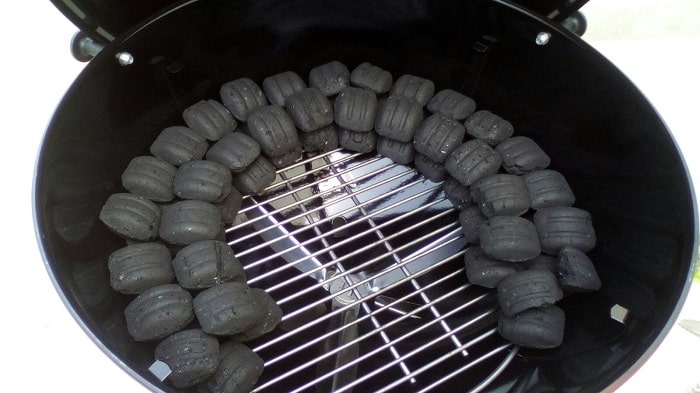
Vents set the heat once the coals are in. More air through the bottom vent means a hotter fire. For low and slow, my snake method guide recommends starting with the bottom vent fully open and the top vent half open, then adjusting from there.
How much charcoal do you need?
| Setup (22-inch kettle) | Charcoal | Source |
|---|---|---|
| Direct, high heat | 45–50 briquettes | Weber |
| Direct, medium-high heat | 35–40 briquettes | Weber |
| Direct, medium heat | 30–35 briquettes | Weber |
| Two-zone, indirect or smoking | Chimney about half full, coals over one-third to one-half of the grate | Weber |
| A typical grilling session | About 4 lb (a standard chimney) | Kingsford |
Weber, 57cm (22″) kettle direct setup and How to Smoke on a Charcoal Grill; Kingsford FAQ and chimney guide. Counts are for Weber briquettes; lump charcoal varies in size, so go by volume. Checked October 2026.
Smaller grills need less, and briquettes and lump burn differently (see lump charcoal vs briquettes). For long cooks and other grill sizes, see how much charcoal to use.
When is charcoal ready to grill?
Go by what the coals look like, not by the clock. Check all five:
- Gray ash on most of the coals. Kingsford says to cook when the coals are covered in gray ash. Weber waits until at least 80% are ashed over before setting up for indirect cooking. From a chimney, pour when the top coals start to gray; they finish catching while the grill preheats.
- A glow under the ash and small, steady flames, not tall ones or thick smoke.
- The starter has burned away. With lighter fluid or match-light charcoal, wait until the coals are gray all over before any food goes on.
- The grate is hot. Lid on for about 10 to 15 minutes, then brush the grate.
- The hand test gives the heat you want (below), or a thermometer at grate level does.
How hot is it? The hand test
Hold your palm flat over the coals at the height Weber uses, 5 inches above the grate (about a soda can’s height), and count until you have to pull away.
| Heat | Grill temperature | Weber: seconds at 5 in above the grate | NDSU Extension: seconds at 4 in above the coals |
|---|---|---|---|
| High | 450–550°F (230–290°C) | 2–4 | Under 2 sec ≈ 375°F (190°C) |
| Medium | 350–450°F (180–230°C) | 5–7 | 4 sec ≈ 300–350°F (150–175°C) |
| Low | 250–350°F (120–180°C) | 8–10 | — |
Approximate. Weber, Measuring Heat: The Hand Test; North Dakota State University Extension, Prairie Fare: Spring Grilling Season Stirs the Senses (Julie Garden-Robinson). The two disagree by a few seconds at the same heat, which shows how rough the test is. Weber: pull your hand away before it hurts, and keep sleeves clear. Checked October 2026.
Can you trust the lid thermometer?
Not to the degree. The dial in a kettle lid measures the air at the top of the dome, not the grate where the food sits. As I wrote in my Weber Master Touch review, the gauge reads correctly for where it is; it’s just in the wrong place.
Its reading also shifts if you put the lid back turned differently, closer to or further from the coals. For anything that matters, use a probe clipped at grate level: my grill thermometer guide covers them. Cook meat to a safe internal temperature, checked with a food thermometer, whatever the dome says.
How long does charcoal take to be ready?
Usually 15 to 30 minutes plus the preheat, depending on the method (see the comparison table). America’s Test Kitchen allows 20 to 30 minutes for a full 6-quart chimney, with lump quicker than briquettes, and advises watching the coals rather than setting a timer.
Can you add unlit charcoal to a lit fire?
It depends on the charcoal. Weber says to add standard briquettes fully lit, because food can pick up the aroma of partly lit briquettes, while lump charcoal and hardwood briquettes can go on lit or unlit. Never add match-light charcoal to a lit fire (Kingsford).
The snake and minion methods are built on unlit coals catching slowly from lit ones, with the lid on and the food set well away from the fire.
What are the charcoal grill safety rules?
Most lighting guides stop at “be careful”. Here’s what the fire and product-safety agencies actually say.
- Never use gasoline. NFPA: “Never use gasoline or any other flammable liquid except charcoal starter or lighter fluid to start a charcoal fire.”
- Never add starter fluid to a lit fire. NFPA: “Never add charcoal starter fluid to coals or kindling that has already been ignited.” Kingsford adds “or warm”.
- Grill outdoors, well away from the house. NFPA and the US Fire Administration: keep the grill well away from the home and deck railings, and out from under eaves and overhanging branches. USFA: “Do not store or use a grill on a porch or balcony.”
- Never burn charcoal indoors, including in a garage or tent. CPSC: “Never burn charcoal inside of homes, vehicles, tents, or campers,” and “Do not cook on a charcoal grill in a garage, even with the door open.” It gives off carbon monoxide, which has no odor, and CPSC says this holds “even if ventilation is provided.”
- Don’t bring the grill inside while the coals are warm. CPSC: charcoal produces carbon monoxide until it’s completely out, so “do not store the grill indoors with freshly used coals.”
- Keep a 3-foot zone clear of children, pets and anything that can burn, and never leave a lit grill unattended (NFPA, USFA).
- Dispose of the ash cold. NFPA: let the coals cool completely, then empty them into a metal container with a tight-fitting lid, used only for coals and kept outside, away from anything that can burn. “Never empty coals directly into a trash can.”
NFPA, Grilling Safety Facts & Resources; US Fire Administration, Outdoor Fire Safety (reviewed August 2024); CPSC, Never Use Charcoal Grills Indoors (1999, including the warning required on charcoal bags) and its February 2026 carbon monoxide warning; Kingsford, How to Light Charcoal with Lighter Fluid. Checked October 2026.
Did you know? In NFPA’s 2020–2024 figures, July is the peak month for grill fires, nearly a quarter of grill fires in buildings started on an exterior balcony or open porch, and an average of 21,682 people a year went to emergency rooms with grill injuries (CPSC data).
To finish safely, close the lid and every vent to smother the coals: see how to put out a charcoal grill and how to dispose of charcoal.
Why won’t my charcoal light?
- The vents are shut or buried in ash. Weber notes that built-up ash eventually covers the vents and starves the coals of air. Empty it and open everything.
- The lid went on too soon. Weber leaves the lid off while the fire gets going, so oxygen can reach the coals.
- The starter blew out. Wind can put out cubes before the charcoal catches. Check they’re all burning before you walk away.
- The charcoal is damp. See does charcoal go bad, and what if it gets wet.
- The match-light bag was left open. Kingsford says the fluid evaporates, making the briquets harder to light.
Whatever the cause, don’t fix it with more lighter fluid on warm coals. Fill a chimney and start again.
