How to calibrate a thermometer: pack a glass with crushed ice, add water to just below the top of the ice, wait a minute, then stir the probe in the middle without touching the glass. It should read 32°F (0°C). If it doesn’t, turn a dial’s calibration nut, use a digital model’s CAL or offset setting, or note the error and cook to it.
Boiling water works as a second check, but only against your altitude’s boiling point: 212°F at sea level, about 203°F at 5,000 ft (table below).
How do you calibrate a thermometer in ice water?
The ice bath is the test the USDA calls best for most thermometers, and the one ThermoWorks builds its calibration advice around. Done carefully, ThermoWorks says the bath sits at 32.0°F within ±0.1°F.
- Fill a tall glass or jar to the top with ice. Crushed ice is best because it leaves fewer gaps; cubes work.
- Add cold water slowly until it sits about ½ inch below the top of the ice. Too much water makes a warm glass of water with ice floating in it.
- Wait a minute or two. If the ice lifts off the bottom, pour off some water and add more ice.
- Put the probe in the middle, at least 2 inches deep (or past the minimum-depth mark on a leave-in probe), clear of the sides and bottom.
- Stir gently with the probe so the tip isn’t resting against one cube, and wait for the reading to settle: about 30 seconds for most probes, a minute or more for a dial.
- Read it. A thermometer that shows 32°F (0°C), or is within its maker’s stated accuracy, needs nothing.
Why a cup of ice water fails: ThermoWorks warns that a plain cup of ice water can read 12°F or more too warm. Ice floating in water leaves warmer water at the bottom of the glass, which is exactly where a probe tends to sit. The fix is more ice than water and a stir.
How do you check a thermometer in boiling water?
Use boiling water as a second check near cooking temperatures, not as your main test. ThermoWorks calls it trickier than the ice bath and says you may not need it unless you suspect your thermometer is off at higher temperatures.
- Bring at least 4 inches of clean water to a full rolling boil. USDA notes distilled water is needed for true accuracy; tap water is close enough for a kitchen check.
- Look up your boiling point in the altitude table. Only at sea level is it 212°F.
- Hold the probe at least 2 inches into the water, clear of the bottom and sides. The pan bottom is hotter than the water.
- Wait at least 30 seconds for the reading to settle, keeping your hand out of the steam (tongs or a clip help).
- Compare the reading with your altitude’s boiling point, not with 212°F.
What is the boiling point of water at different altitudes?
Water boils at a lower temperature as you go up, because the air pressure on it falls. USDA’s rule of thumb is just under 1°F lower for every 500 feet. The table below is worked out from the standard atmosphere, so you can read off your own elevation.
Or type your elevation into this calculator, which uses the same formula, and add what your thermometer read in boiling water to see how far off it is.
At 0 ft (0 m), for pure water on an average-pressure day. The weather can move it by about 1.5°F (0.8°C).
Where the numbers come from (checked October 2026)
Air pressure at your elevation from the US Standard Atmosphere: pressure (hPa) = 1013.25 × (1 − feet ÷ 145,366.45)5.2553. Boiling point at that pressure from the Antoine equation for water: log10 P = 5.08354 − 1663.125 ÷ (T − 45.622), P in bar, T in kelvin. The altitude table on this page uses the same method. National Weather Service: pressure altitude · NIST Chemistry WebBook: water, Antoine equation · USDA FSIS: High Altitude Cooking
| Altitude | Metres | Water boils at (°F) | (°C) | Standard air pressure |
|---|---|---|---|---|
| Sea level | 0 m | 212.0°F | 100.0°C | 29.92 inHg |
| 500 ft | 152 m | 211.1°F | 99.5°C | 29.38 inHg |
| 1,000 ft | 305 m | 210.2°F | 99.0°C | 28.86 inHg |
| 1,500 ft | 457 m | 209.3°F | 98.5°C | 28.33 inHg |
| 2,000 ft | 610 m | 208.4°F | 98.0°C | 27.82 inHg |
| 2,500 ft | 762 m | 207.4°F | 97.5°C | 27.31 inHg |
| 3,000 ft | 914 m | 206.5°F | 97.0°C | 26.82 inHg |
| 3,500 ft | 1,067 m | 205.6°F | 96.5°C | 26.32 inHg |
| 4,000 ft | 1,219 m | 204.7°F | 95.9°C | 25.84 inHg |
| 4,500 ft | 1,372 m | 203.8°F | 95.4°C | 25.36 inHg |
| 5,000 ft | 1,524 m | 202.9°F | 94.9°C | 24.89 inHg |
| 5,500 ft | 1,676 m | 202.0°F | 94.4°C | 24.43 inHg |
| 6,000 ft | 1,829 m | 201.0°F | 93.9°C | 23.98 inHg |
| 6,500 ft | 1,981 m | 200.1°F | 93.4°C | 23.53 inHg |
| 7,000 ft | 2,134 m | 199.2°F | 92.9°C | 23.09 inHg |
| 7,500 ft | 2,286 m | 198.3°F | 92.4°C | 22.65 inHg |
| 8,000 ft | 2,438 m | 197.4°F | 91.9°C | 22.22 inHg |
| 8,500 ft | 2,591 m | 196.5°F | 91.4°C | 21.80 inHg |
| 9,000 ft | 2,743 m | 195.5°F | 90.9°C | 21.39 inHg |
| 9,500 ft | 2,896 m | 194.6°F | 90.3°C | 20.98 inHg |
| 10,000 ft | 3,048 m | 193.7°F | 89.8°C | 20.57 inHg |
Calculated for this guide, October 2026, for pure water on an average-pressure day. Air pressure at each altitude from the US Standard Atmosphere, using the National Weather Service’s pressure-altitude formula: pressure (hPa) = 1013.25 × (1 − feet ÷ 145,366.45)5.2553. Boiling point from that pressure with the Antoine equation for water in the NIST Chemistry WebBook (log10 P = 5.08354 − 1663.125 ÷ (T − 45.622), P in bar, T in kelvin). Checked against USDA FSIS’s High Altitude Cooking figures: 208°F at 2,000 ft and about 198°F at 7,500 ft.
Did you know? The weather moves the boiling point too. Working the same formula, water at sea level boils at about 211.3°F under a stormy 1,000 hPa low and 212.8°F under a 1,030 hPa high. That 1.5°F swing is bigger than the stated accuracy of a good instant-read thermometer, so a boiling test that’s off by a degree may not be the thermometer’s fault.
Don’t know your elevation? A map app or your phone’s compass app often shows it. For Denver, at about 5,280 ft, the table gives 202.4°F; ThermoWorks quotes water there as typically boiling at 202°F (94°C).
Ice bath or boiling water: which test is more accurate?
The ice bath, for almost everyone. Its reference temperature stays at 32°F wherever you live, while the boiling point moves with your altitude and the weather. USDA calls the ice method best for most thermometers and keeps boiling water for checking higher temperatures.
| Ice bath | Boiling water | |
|---|---|---|
| Should read | 32°F (0°C) anywhere | 212°F at sea level only; see the altitude table |
| Changes with altitude | No | Yes, just under 1°F per 500 ft |
| Changes with the weather | No | Yes, about 1.5°F between stormy and settled weather |
| Common set-up error | Too much water: reads warm, up to 12°F or more | Probe on the pan bottom: reads hot |
| Tap water OK? | Yes | Close; USDA says distilled for true accuracy |
| Burn risk | None | Steam and splashes |
| Best for | Checking and adjusting any probe thermometer | A second check near cooking temperatures |
Sources: USDA FSIS Kitchen Thermometers (updated March 2025) and High Altitude Cooking; ThermoWorks, How to create a properly made ice bath and How to check your thermometer. Weather row: calculated as in the altitude table note. Checked October 2026.
The two tests together are better than either alone. If a thermometer reads 1°F high in ice and 1°F high in boiling water, the error is steady and an offset will fix it. If the two errors differ a lot, the sensor may be failing; contact the maker rather than adjusting.
How do you adjust a thermometer that reads wrong?
First check the maker’s stated accuracy. ThermoWorks’ rule is simple: if the reading is within the specified tolerance, don’t adjust it. A ThermoPop 2 that reads 32.8°F is inside its ±1°F spec and is working as sold.
If it’s outside the spec, what you can do depends on the type of thermometer:
| Type | Can you adjust it? | How |
|---|---|---|
| Dial (bimetal) instant-read or oven-safe | Some models | Turn the hex nut under the dial with pliers or a small wrench until the needle reads 32°F |
| Digital instant-read with a CAL button or calibration mode | Yes | Calibrate in the ice bath, following the manual |
| Wireless or app thermometer with an offset setting | Yes, per probe | Enter the error as an offset in the app |
| Sealed digital, oven-cord or smart probe with no setting | No | Note the error and cook to it, or contact the maker |
| Infrared (surface) thermometer | Not usually at home | Check against the ice bath surface; contact the maker if out of spec |
Sources: USDA FSIS Kitchen Thermometers (calibration by type, March 2025); ThermoWorks, Calibrating your infrared thermometer with a properly made ice bath; makers’ manuals and product pages in the next table. Checked October 2026.
Dial thermometers: the calibration nut
Many dial thermometers have a small hex nut where the stem meets the back of the dial. Hold the nut with pliers or a wrench and turn the dial (or the nut, depending on the design) until the needle points to 32°F, then put it back in the ice to confirm.
South Dakota State University Extension describes the same nut-and-pliers fix.
These let you correct the reading yourself. The details vary by model, so the manual is the authority. These are the named examples I could confirm from the makers:
| Thermometer | Maker’s stated accuracy | User adjustment |
|---|---|---|
| ThermoWorks Thermapen ONE | ±0.5°F (−4 to 248°F) | Yes: ThermoWorks publishes calibration trim instructions for it |
| ThermoWorks ThermoPop 2 | ±1°F (14 to 208°F) | None documented on its product page; ThermoWorks offers lab recalibration |
| ThermoPro (now TempPro) TP19H | ±0.9°F (14 to 212°F) | Yes: hold CAL for 5 seconds in the ice bath; the bath must read 28 to 36°F or calibration won’t run |
| ThermoPro (now TempPro) TP620 | ±0.9°F | Yes: listed as user calibration |
| Inkbird IHT-1P | ±2°F (±1°C) | Yes: calibration mode, ±5°F (±3°C) range |
| Inkbird IBBQ-4BW | — | Yes: per-probe calibration in the app, ±12.6°F (±7°C) range |
| ThermoWorks Signals | ±1.8°F (−4 to 248°F) | None documented on its product page |
| Meater probes | Ice bath should read within ±5°F (Pro) or ±7°F (Alpha collection) | None described; Meater Pro shows its factory calibration certificate in the app; contact Meater if outside range |
| Weber Connect | — (not stated) | None I could find; check with Weber |
Sources, October 2026: ThermoWorks Thermapen ONE, ThermoPop 2 and Signals product pages (specs and downloads); the TP19H operating manual and TP620 product page; Inkbird’s IHT-1P and IBBQ-4BW product pages; Meater support, Ice Bath Test and calibration-certificate article. “None documented” means I found no user adjustment in the maker’s own material, not that one can’t exist. ThermoWorks is selling off the Thermapen ONE as of October 2026, with the Thermapen NANO newer.
On an app thermometer, an offset usually means entering the correction: a probe that reads 2°F high gets −2. Apps differ on the sign, so put the probe back in the ice after saving and check it now reads 32°F.
Sealed digital thermometers and smart probes
USDA says digital oven-cord thermometers can’t be calibrated, and many cheap pocket digitals have no setting either. You can still test them.
If a sealed thermometer is outside its spec, write the error on a small label on the thermometer and use the method in the next section. If it’s badly out, contact the maker; a thermometer under warranty may be replaced.
Infrared thermometers
An infrared gun reads surfaces, so you aim it at the ice bath instead of dipping it. ThermoWorks’ method:
- Make the ice bath as above, then open a patch of water with no floating ice.
- Set the emissivity to 0.95 or 0.97.
- Hold the gun close and square to the surface, so the spot doesn’t take in the glass.
- It should read 32°F within its stated accuracy.
ThermoWorks says infrared thermometers can’t usually be calibrated at home, so contact the maker if it’s out. My guide to the best infrared thermometers explains why they can’t replace a probe for meat.
How do you cook with a thermometer that’s a few degrees off?
Work out the error once, then shift the target you cook to.
If the thermometer reads high, cook to a higher displayed number; if it reads low, cook to a lower one. USDA’s own example: a thermometer reading 214°F in boiling water at sea level is 2°F high, so ground beef that must reach 160°F is done when it shows 162°F.
| Ice bath reads | Error | Chicken (safe at 165°F): cook until it shows | Burgers (safe at 160°F): cook until it shows |
|---|---|---|---|
| 34°F | 2°F high | 167°F | 162°F |
| 33°F | 1°F high | 166°F | 161°F |
| 32°F | None | 165°F | 160°F |
| 31°F | 1°F low | 164°F | 159°F |
| 30°F | 2°F low | 163°F | 158°F |
Safe minimum temperatures (165°F poultry, 160°F ground meat) from USDA FSIS. Shown temperature = safe temperature + error. This assumes the error is the same at cooking temperatures; a boiling-water check confirms it. October 2026.
A thermometer that reads low is the dangerous one: it tells you the chicken is done before it is. If yours reads low and you can’t adjust it, fix that first or replace it.
What did my thermometers read in ice and boiling water?
When I reviewed five wireless thermometers in 2022, I ran both tests on each at home, about 144 ft above sea level, where water should boil at about 211.7°F. All five were close enough to cook with, and none read exactly 32.0°F in ice.
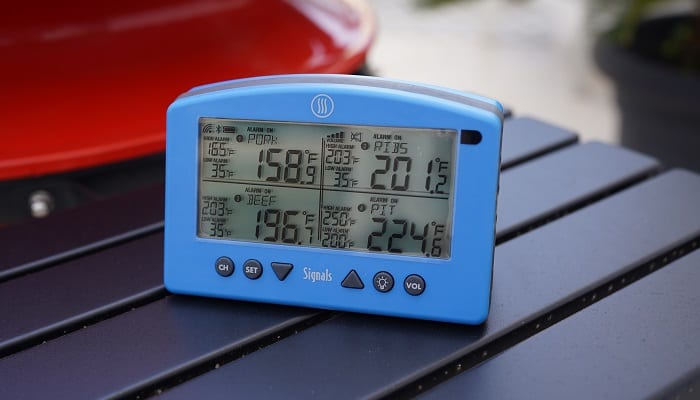
| Thermometer | Ice water (should be 32°F) | Boiling water (should be about 211.7°F) | Maker’s stated accuracy |
|---|---|---|---|
| ThermoWorks Signals | 32.3°F | 211.7°F | ±1.8°F |
| ThermoPro TP930 | 32.3°F | 211.2°F | ±1.8°F |
| ThermoPro TP27 | 32.7°F | 211.2°F | ±1.8°F (14 to 212°F) |
| Inkbird IBBQ-4BW | 30.9°F | 212.4°F | ±2.7°F (14 to 482°F) |
| Weber Connect | 33°F | 210°F | — (Weber didn’t state one) |
My readings, June to September 2022, from each linked review. Stated accuracy as published by each maker at the time of the review. Expected boiling point for 144 ft from the altitude formula above (211.7°F).
The Inkbird read low in ice and high in boiling water, which is why I check at both ends. An offset taken at 32°F alone would have pushed its high-end readings further out.
How often should you calibrate a meat thermometer?
Neither USDA nor ThermoWorks sets a fixed schedule; ThermoWorks says to double-check “every so often” and keep a record. I’d check:
- when it’s new, before the first cook;
- after it’s been dropped or knocked;
- before a cook where a few degrees matter: poultry, a big brisket, sugar work;
- any time a reading doesn’t match what you see on the plate.
Choosing a new one? My guides to the best instant-read thermometers and the best wireless meat thermometers list each pick’s stated accuracy, and more guides like this one are in BBQ Tips.
